Foundation Repair in Burleson, TX
Foundation repair in Burleson, TX for homes moving on expansive clay soil. Learn the warning signs, the repair process, and how to decide your next step.
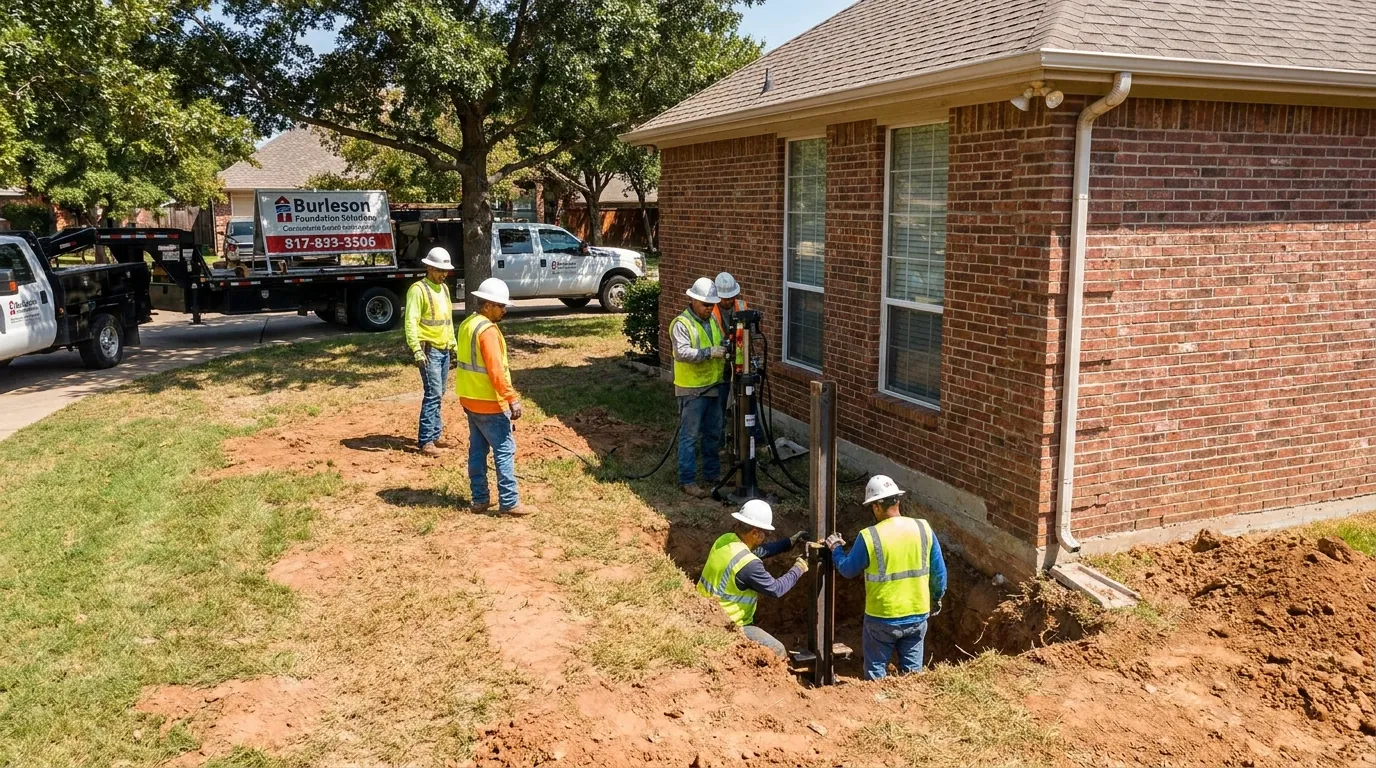
When a Burleson foundation needs repair
If you are searching to repair a foundation in Burleson, you are almost certainly dealing with the same underlying cause as most of your neighbors: expansive clay soil. The ground beneath most Burleson homes swells when it soaks up rain and shrinks as it dries out through a hot Texas summer. That constant up-and-down movement pushes and pulls on a foundation until parts of it lift, drop, or crack.
Foundation movement rarely announces itself all at once. It shows up as a door that used to close cleanly and now sticks or swings open on its own. It shows up as stair-step cracks in exterior brick, as gaps opening between the wall and the crown molding, or as a hairline crack chasing a diagonal line across drywall above a window. On the outside you may see separation where the driveway or porch meets the house.
The goal of foundation repair is to stabilize the structure and, where possible, bring it back toward its original elevation. That is done by transferring the weight of the home onto support that reaches below the active clay zone, so seasonal moisture swings no longer move the house. Whether your home sits on a concrete slab or a pier-and-beam frame changes the method, which is why an accurate diagnosis comes first.
How foundation repair works
Every job is different, but repair on Burleson clay generally follows the same path from diagnosis to backfill.
-
Inspection and elevation survey
The work starts with a walk-through of the interior and exterior symptoms and a floor-elevation survey that maps how much and where the foundation has moved. This tells us whether the problem is settlement, heave, or both. See our full foundation inspection for what that visit covers.
-
A repair plan matched to the foundation type
Slab homes and pier-and-beam homes call for different fixes. We identify the low points, the load path, and the number of support points needed to lift and hold the affected area.
-
Installing piers
Access holes are dug at the marked points. Steel or concrete piers are driven or pressed down through the unstable clay to firmer bearing soil or bedrock, then the load of the home is transferred onto them.
-
Lifting and stabilizing
Using hydraulic equipment, crews raise the settled sections in small increments while watching doors, windows, and cracks close. The aim is a stable, even structure rather than forcing the slab past what it can take.
-
Backfill and cleanup
Excavations are filled and compacted, concrete is patched, and the site is restored. Follow-up drainage or watering guidance helps keep the soil moisture steady so the repair holds.
Local soil and why timing matters
Burleson's wet-and-dry cycle is the engine behind most local foundation trouble. A wet spring saturates the clay and it expands; a dry, hot summer pulls the moisture back out and the clay contracts. Sudden storms make it worse by dumping water against a foundation that was bone dry the week before. The bigger the swing, the more the ground moves under your home.
That is why drainage and watering are part of a lasting fix, not an afterthought. Poor grading and downspouts that dump next to the slab keep one corner of the house wet while the far side dries out, which twists the foundation. Correcting how water moves around the home often prevents the next round of movement. If your gutters and grading are working against you, drainage correction usually belongs in the plan alongside pier work.
Waiting rarely makes a foundation cheaper to fix. Small cracks and a slightly sticking door are far less involved to address than a house that has dropped an inch across a whole wing. Homes on pier-and-beam framing often show early warning through bouncy or sloping floors, and pier and beam leveling can catch that movement before it damages finishes. If you are not sure which category your home falls into, reach out and we will help you sort out the next step.
Frequently asked questions
How do I know if my foundation actually needs repair?
Sticking doors, stair-step cracks in brick, diagonal cracks over doors and windows, and sloping floors are the common signs. A floor-elevation survey confirms whether the movement is enough to warrant repair or just needs monitoring.
Will foundation repair fix my cracked drywall and brick?
Repair stabilizes the foundation and often closes many cracks as the structure returns toward level. Cosmetic patching of drywall, paint, and mortar is usually done afterward once the movement has stopped.
How long does a typical repair take?
Many residential repairs are completed in a few days, depending on the number of support points and site access. Larger or harder-to-reach jobs take longer. We give a realistic timeframe after the inspection.
Can I do anything to keep the problem from coming back?
Yes. Keeping soil moisture steady with proper drainage and consistent watering during drought is the single biggest thing a homeowner can do. Directing downspouts away from the slab also helps a great deal.
Talk to someone about your job
Call to describe the problem and get a quote for work in Burleson, TX.